This paper introduces the Kardashev-Vestorp Energy Efficiency Parameter (KEEP), a framework for assessing the infrastructure requirements of civilizational energy systems. Building on Nikolai Kardashev’s 1964 classification scheme and Carl Sagan’s quantitative extensions, KEEP addresses a gap in existing frameworks by distinguishing between useful energy output (P) and the installed primary capture capacity required to generate it.
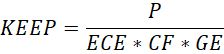
The core relationship is formalized as: KEEP = P / (ECE × CF × GE), where ECE is Energy Conversion Efficiency, CF is Capacity Factor, and GE is Grid Efficiency. KEEP represents the installed nameplate capacity for primary energy capture, a capacity-planning metric that quantifies the infrastructure burden required to sustain a given level of useful output.
Applying baseline values representative of current technology (ECE = 0.28, CF = 0.5, GE = 0.95), this analysis demonstrates that achieving Type I civilization status (10¹⁶ W of useful output) requires approximately 7.52 × 10¹⁶ W of installed primary capture capacity, a 7.5× multiplier over the useful output. Scenario analysis shows this multiplier ranges from 2.6× (hydroelectric-dominated) to 19× (solar PV-dominated), highlighting the critical importance of technology selection.
The framework extends to multi-source energy mixes and storage-integrated systems (IKEEP), providing practical tools for energy infrastructure planning. By quantifying the gap between civilizational energy aspirations and infrastructure reality, KEEP transforms the Kardashev Scale from theoretical classification into actionable systems engineering.
Exciting News! You can now download the 4 books published last year for free, directly via the Bitcoin blockchain. Dive into knowledge securely and decentralized! 📚✨
And remember — the moon is not a planet!
🌕 First Block A quirky Bitcoin miner living solo on the Moon, growing mycelium for breakfast, engaging in clandestine meetings at the Cargo Center, and waiting 137 days for his “Celebration” alarm to activate.
🌊 Seaside Boys After selling his African solar farm for Bitcoin, an obsessed miner teams up with ex-DARPA researcher Dr. Zhang to deploy autonomous titanium pods 500 meters beneath international waters, where his “Leviathan Protocol” will create self-repairing, self-defending nodes powered by crab-sized robots
A paranoid Bitcoin holder encrypts private keys within bacteria, olive trees, and bioluminescent coral, decryptable only under specific seasonal conditions, such as the summer solstice.
🔬 Quantum Hunter A researcher develops a quantum computer designed to recover billions of dormant Bitcoin wallets, raising questions about the ethics of “reclaiming lost fortunes” amid the hum of superconducting qubits.
The original Kardashev Scale, proposed by Russian astrophysicist Nikolai Kardashev, classifies civilizations based on their capacity to harness energy. The scale comprises three main types:
TypeI: A planetary civilization capable of utilizing all available energy resources on its home planet, estimated at approximately 10^16 watts (W) for Earth.
Type II: A stellar civilization that can harness the energy output of its entire star, estimated at about 4*10^26 watts (W) for the Sun.
Type III: A galactic civilization that can control energy on the scale of its entire galaxy, approximately 4*10^37 watts (W) for the Milky Way.
While the Kardashev Scale provides a valuable framework for categorizing civilizations, it primarily emphasizes raw energy output, neglecting the efficiency and sustainability of energy usage. This limitation underscores the necessity for the Kardashev-Vestorp Energy Efficiency Parameter (KEEP).
KEEP aims to illustrate the amount of energy required by the human population to develop its energy infrastructure to achieve Type I, II, or III civilization status, as defined by Kardashev’s civilization types. This scale quantifies the capacity of the total energy system necessary for humanity to harness and utilize energy on a planetary (Type I), stellar (Type II), or galactic (Type III) scale.
To determine Kardashev-Vestorp Energy Efficiency Parameter (KEEP), use the formula:
Where:
KEEP = Installed nameplate capacity for primary energy capture (in watts).
P = The total energy consumption of the civilization (in watts).
ECE = Energy Conversion Efficiency of the energy generation system (expressed as a decimal).
CF = Capacity Factor of the energy generation system (expressed as a decimal).
GE = Grid efficiency (expressed as a decimal).
Kardashev-Vestorp Energy Efficiency Parameter (KEEP) Calculator
Kardashev-Vestorp Energy Efficiency Parameter (KEEP) Calculator
Note: To input very large numbers like 10^16, you can use scientific notation, e.g., 1e16.
Understanding the Bitcoin Risk-Free Rate Bitcoin operates in a unique financial ecosystem, distinct from traditional markets. To reflect the true cost of collateralized Bitcoin funding, we propose a Bitcoin Risk-Free Rate – a benchmark derived from Bitcoin-native lending activities. Unlike fiat-based benchmarks like SOFR, this rate is rooted in decentralized, transparent, and auditable Bitcoin markets, ensuring alignment with Bitcoin’s core principles.
The Challenge: Bitcoin’s Fragmented Lending Landscape Bitcoin’s 24/7 trading, extreme volatility, and lack of centralized collateral mechanisms create a lending ecosystem vastly different from traditional markets. While decentralized finance (DeFi) protocols and centralized exchanges (CEXs) facilitate lending, the market remains fragmented. No standardized benchmark exists to reflect the true cost of Bitcoin funding, a gap that hinders institutional adoption and regulatory clarity.
Why Bitcoin Needs a Native Benchmark Bitcoin’s unique characteristics: Continuous trading, price volatility, and decentralized collateral, necessitate a benchmark tailored to its ecosystem. Unlike stablecoin lending rates (e.g. USDT), which are credit-risk-dependent, a Bitcoin benchmark must focus on collateralized lending, leveraging the asset’s inherent properties and blockchain transparency.
A Path Forward: Constructing the Bitcoin Risk-Free Rate To ensure Bitcoin-native rigor, the benchmark must aggregate rates from two pillars:
DeFi Protocols
High-liquidity platforms with transparent, auditable lending data, enabled by blockchain’s immutable ledger.
Future integration: Discreet Log Contracts (DLCs) and Lightning Network data for real-time, low-trust rate discovery.
Centralized Exchanges (CEXs)
Regulated CEXs offering robust lending markets, with transparency standards rivaling traditional repo markets.
Methodology
Volume-Weighted Averages: Prioritize rates from platforms with higher lending volumes to ensure market representation.
Frequency: Compute 8-hour intervals and aggregate into a daily benchmark, mirroring the need for timely data in Bitcoin’s 24/7 market.
Privacy-Preserving Audits: Utilize zero-knowledge proofs to ensure auditability while preserving user privacy, aligning with Bitcoin’s ethos of decentralization.
Example Calculation: A Simplified Snapshot Hypothetical 24-hour data from three platforms:
Platform
Rate
24h Volume
LTV
Weight
Weighted Rate
DeFi Protocol
0.02%
$1B
75%
57.1%
0.0114%
Centralized Exchange
0.01%
$500M
80%
28.6%
0.0029%
CeFi Protocol
0.03%
$250M
70%
14.3%
0.0043%
24-Hour Benchmark
0.0186%
(Note: Rates and volumes are illustrative; actual implementation requires real-time data feeds.)
Why Perpetual Futures and Stablecoin Rates Fall Short While perpetual futures funding rates offer insight into Bitcoin sentiment, they are not a proxy for funding costs:
Nature of Transactions: Futures are speculative derivatives, not direct lending/borrowing.
Leverage Bias: Funding rates are skewed by leveraged traders’ positions and can be manipulated.
Transparency Gap: Futures lack the transaction-level granularity needed for a reliable benchmark.
Critics may argue that existing futures markets suffice, but their speculative nature and lack of collateral granularity make them unfit for institutional-grade pricing.
Stablecoin lending rates, meanwhile, reflect credit risk rather than collateralized Bitcoin lending, making them unsuitable as a benchmark for Bitcoin’s unique ecosystem.
Addressing Key Risks
Data Consistency: Standardize reporting across platforms via APIs and third-party audits, leveraging blockchain transparency and zero-knowledge proofs for privacy-preserving verification.
Governance & Incentives: To ensure adoption, the benchmark could be governed by a decentralized consortium of DeFi protocols, CEXs, and institutional stakeholders. Incentives such as preferential lending terms or enhanced audit transparency could encourage platform participation.
Market Evolution: Design the benchmark to adapt to Bitcoin-native innovations (e.g., Lightning Network, DLCs, Etc.).
Risk Metrics: Embed LTV ratios and collateral quality to reflect counterparty risk.
Conclusion: A Call for Systemic Advancement The Bitcoin Risk-Free Rate is not merely a technical endeavor, it is imperative for establishing Bitcoin as a global financial asset. By anchoring Bitcoin’s lending market in transparency, volume-weighted data, and risk-adjusted metrics, we can:
Reduce systemic risk through reliable pricing.
Attract institutional capital by meeting regulatory standards.
Foster innovation in Bitcoin-native and decentralized markets.
As industry leaders, academics, and policy makers, the opportunity to shape this framework could redefine financial infrastructure for the digital age. Let’s collaborate to build a benchmark that stands the test of time, one that reflects Bitcoin’s unique properties while providing the stability and trust required for global adoption.
While the Bitcoin Risk-Free Rate is initially denominated in USD for regulatory clarity, its ultimate goal is to transition to BTC-denominated rates, reflecting Bitcoin’s emergence as the global unit of account.
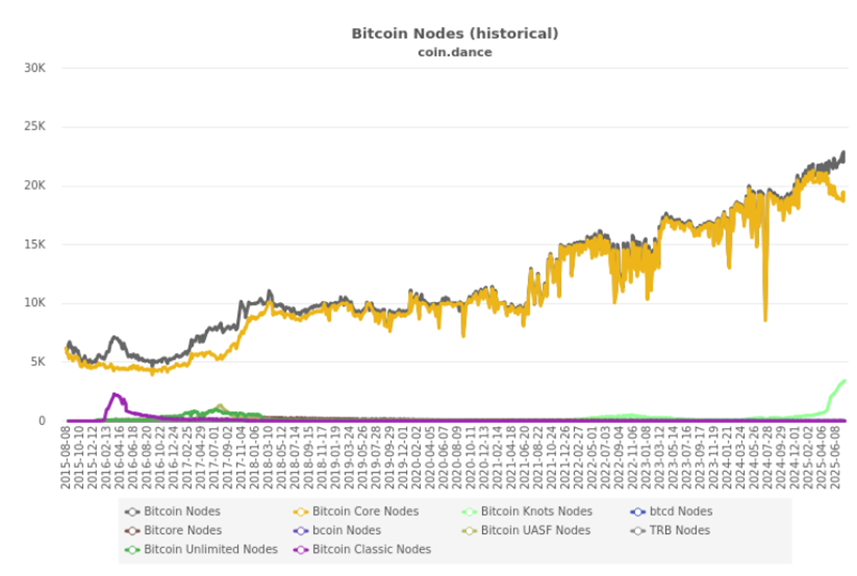
The Bitcoin network is more robust than ever. Recent data from Coin.dance (21 July 2025) shows the number of reachable public nodes has climbed to an all-time high, surpassing 22,500.
This growth signals a healthy, decentralized network. Yet a closer look at the software these nodes run reveals a deeper debate about Bitcoin’s very purpose.
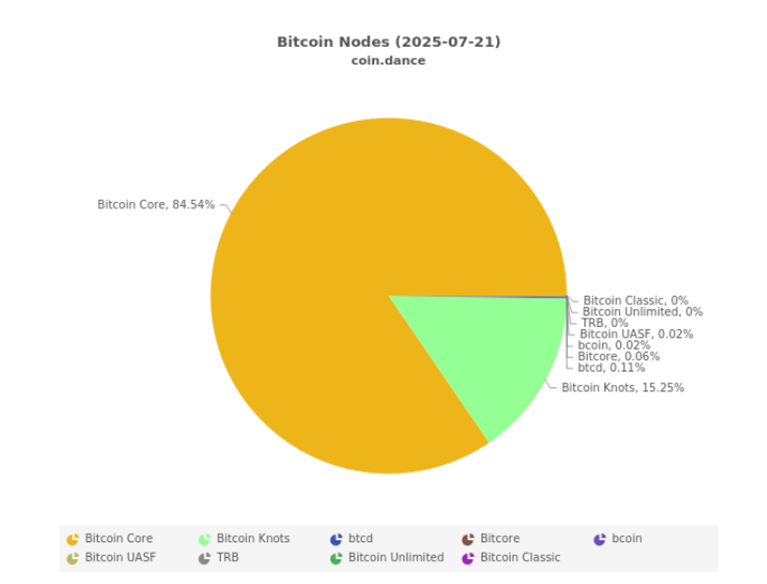
While Bitcoin Core remains the dominant client, an alternative implementation, Bitcoin Knots, has seen a notable increase in adoption. This shift appears to be catalyzed by a proposed policy change in an upcoming Bitcoin Core release concerning data storage on the blockchain.
The Catalyst: A Policy Change for OP_RETURN
OP_RETURN is an opcode that lets users embed a small, provably unspendable data payload in a transaction. Since 2016 (0.12.0), Bitcoin Core’s default relay policy has capped that payload at 83 bytes.
On 5 May 2025, Core developers announced they will remove this 83-byte limit in the October v30 release.
Three key points:
This is a policy change, not a consensus change. It affects what a node will relay or accept into its mempool, not what makes a block valid.
The 4 million-weight-unit (≈ 4 MB) block-size limit is unchanged.
No one is forced to change. Operators may skip v30 or run clients such as Bitcoin Knots that enforce stricter rules.
This seemingly minor technical adjustment has reignited a long-standing philosophical debate, creating two distinct camps.
Camp 1: Bitcoin Core
Proponents of removing the OP_RETURN limit argue that attempting to define and filter “arbitrary data/spam” is a futile effort. They believe that censorship resistance is a core feature of Bitcoin. If users are prevented from easily storing data via OP_RETURN, they will find more inefficient and harmful ways to do so, such as embedding data in fake outputs, which permanently bloats the UTXO set (the list of all spendable coins) and harms scalability.
From an economic perspective, this view acknowledges that block space is a commodity. The recent wave of “spam” in the form of Inscriptions, Runes, BRC-20 tokens has dramatically increased transaction fees, directly benefiting miners and strengthening the network’s security budget, a crucial factor as the block subsidy diminishes over time. Allowing data storage opens the door to innovation and new business models built on Bitcoin’s foundation.
Camp 2: Bitcoin Knots
On the other side, the community around Bitcoin Knots and its supporters argue that Bitcoin’s primary and most important use case is as a peer-to-peer electronic cash system. They contend that embedding arbitrary data, whether for JPEGs or tokens, is a misuse of a scarce resource. This “blockchain spam” increases the operational cost of running a full node (due to a larger blockchain size) and distracts from the mission of creating a robust global monetary network. For them, preserving the chain for purely monetary transactions is paramount.
This entire debate is a beautiful illustration of Bitcoin’s decentralized governance in action. There is no central authority to decree what is right. Instead, the network’s direction is shaped by the choices of individual users and node operators.
Regardless of which philosophy you subscribe to, running your own full node is the most powerful action you can take. By running a node, you don’t trust, you verify. You independently validate every transaction and block according to the rules you choose, ensuring your connection to the genuine Bitcoin network and contributing to its health, security, and resilience.
You don’t need to be a miner to support the network. If the resource requirements of a full node seem daunting, a pruned node is an excellent option that requires significantly less disk space.