The Kardashev Scale and Its Limitations
The original Kardashev Scale, proposed by Russian astrophysicist Nikolai Kardashev, classifies civilizations based on their capacity to harness energy. The scale comprises three main types:
Type I: A planetary civilization capable of utilizing all available energy resources on its home planet, estimated at approximately 10^16 watts (W) for Earth.
Type II: A stellar civilization that can harness the energy output of its entire star, estimated at about 4*10^26 watts (W) for the Sun.
Type III: A galactic civilization that can control energy on the scale of its entire galaxy, approximately 4*10^37 watts (W) for the Milky Way.
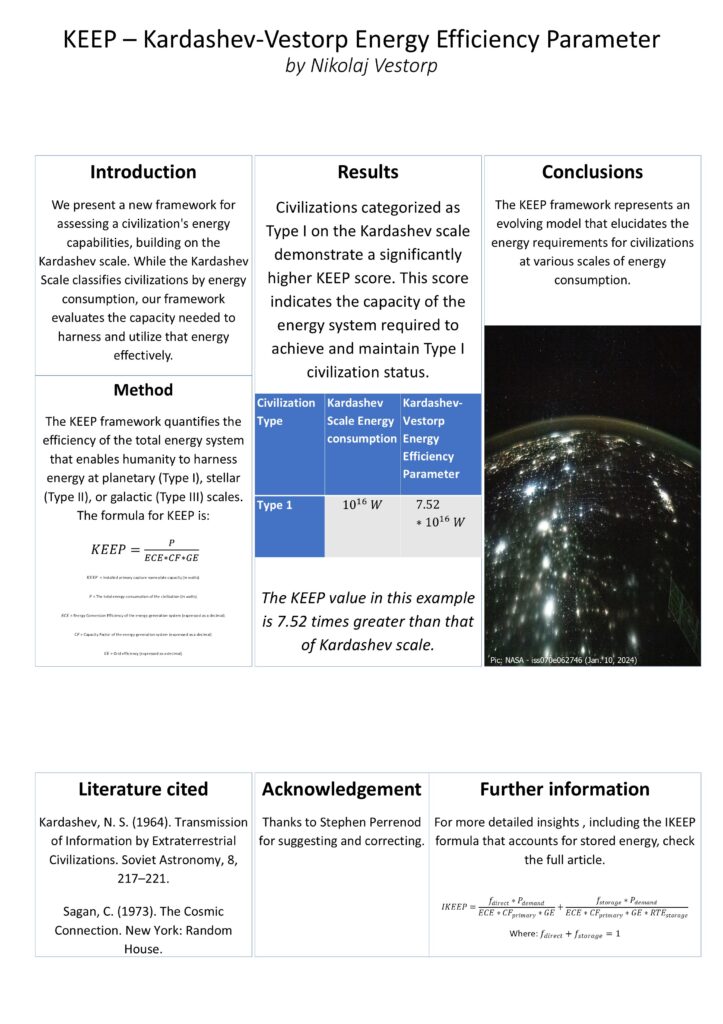
While the Kardashev Scale provides a valuable framework for categorizing civilizations, it primarily emphasizes raw energy output, neglecting the efficiency and sustainability of energy usage. This limitation underscores the necessity for the Kardashev-Vestorp Energy Efficiency Parameter (KEEP).
KEEP aims to illustrate the amount of energy required by the human population to develop its energy infrastructure to achieve Type I, II, or III civilization status, as defined by Kardashev’s civilization types. This scale quantifies the capacity of the total energy system necessary for humanity to harness and utilize energy on a planetary (Type I), stellar (Type II), or galactic (Type III) scale.
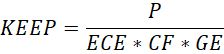
To determine Kardashev-Vestorp Energy Efficiency Parameter (KEEP), use the formula:
Where:
KEEP = Installed nameplate capacity for primary energy capture (in watts).
P = The total energy consumption of the civilization (in watts).
ECE = Energy Conversion Efficiency of the energy generation system (expressed as a decimal).
CF = Capacity Factor of the energy generation system (expressed as a decimal).
GE = Grid efficiency (expressed as a decimal).
Kardashev-Vestorp Energy Efficiency Parameter (KEEP) Calculator
Note: To input very large numbers like 10^16, you can use scientific notation, e.g., 1e16.
Full article landing soon!