The United States claims to hold 8,133 tons of gold — the largest sovereign gold reserve in the world. Yet the Fort Knox depository has undergone only limited audits throughout history, the last notable ones being in 1953 and September 1974. That’s over 50 years without a comprehensive, independent verification. And even the 1974 visit was widely criticized as a superficial, staged tour rather than a rigorous audit.
So let me get this straight: People are supposed to just trust that 8,133 tons of gold — the supposed bedrock of confidence in the U.S. financial system — are actually there, unencumbered, and unmanipulated? No independent real-time verification. No transparency. Just: “trust us.”
This is not a minor detail. This is a scandal hiding in plain sight.
Now contrast that with Bitcoin.
Every single satoshi in existence can be tracked, verified, and audited by anyone, anywhere, at any time. The supply schedule is fixed — 21 million, ever. No exceptions. No backdoor minting. No staged tours. The protocol is the audit.
Want to verify it yourself right now? Download a Bitcoin Node!
For an easy check, use a tool like the Clark Moody Bitcoin Dashboard which lest you monitor in real-time: total supply, block height, hash rate, fees, mempool activity — the complete monetary picture. Full transparency on a screen – Try asking the Fed for the same.
Bitcoin doesn’t ask you to trust. It lets you verify.
- Store of value — cryptographically scarce, immutable 21M cap. No one can secretly inflate it.
- Medium of exchange — permissionless, borderless, 24/7. No intermediaries needed.
- Unit of account — divisible to eight decimal places with zero ambiguity.
People spent decades chanting “audit the Fed” only to realize you can’t audit a system designed to resist transparency. Bitcoin solved this by making the audit permanent, open, and accessible to every human on earth.
8,133 tons of gold — allegedly. 21 million bitcoin — provably.
Don’t trust. Verify.
—
Your Money, Their Mistakes: The Case for Financial Sovereignty
Why citizens deserve the right to invest in Bitcoin instead of being forced into state-managed pension funds
Governments love to tell you they’re protecting your future. They mandate pension contributions, funnel your hard-earned money into state-controlled funds, and then — when billions evaporate — shrug and ask for your continued trust.
Look no further than Denmark’s ATP for a masterclass in everything wrong with forced state-managed retirement savings.
The ATP Disaster: A Timeline of Failure
Billions lost, zero accountability. ATP has squandered enormous sums of Danish citizens’ retirement savings through reckless investment strategies. Leading economists have publicly condemned their model, demanding fundamental changes. Yet the system rolls on.
“Green” investments gone up in smoke. ATP bet big on ESG darlings like the Swedish battery manufacturer Northvolt — investments that have effectively vanished. So much for the promise that bureaucrats know best where to allocate your capital.
Massive energy sector losses. Investments in Ørsted and other energy projects have produced staggering losses. These weren’t small, calculated risks — these were ideologically driven bets made with other people’s money.
The Copenhagen Airport cover-up. When the Danish state bought Copenhagen Airport from ATP, the government actively covered for them, obscuring the problems surrounding the deal. Prime Minister Mette Frederiksen must answer for this. When the state is both the regulator and the enabler, who watches the watchmen?
Administrative bloat beyond parody. The ATP Fund for Posted Workers (AFU) spent over 62 million DKK on administration while paying out only 8.5 million DKK in actual compensation.
ATP failed to disclose 906 million DKK in costly bonuses paid to external asset managers in their 2025 financial report – ATP’s investment employees had received 623 million DKK in bonuses on top of their regular salaries.
That’s a ratio so absurd it can only be described as a system that has — in the Danes’ own words — “løbet løbsk” (run completely off the rails).
The Hypocrisy: Tax Bitcoin, Protect ATP
Here’s what makes this truly outrageous.
While ATP burns through citizens’ savings with near-zero accountability, Prime Minister Mette Frederiksen’s government has made it unnecessarily expensive and difficult for Danish citizens to invest in Bitcoin — an asset that has outperformed virtually every pension fund on earth over any meaningful time horizon.
Danish Bitcoin investors face punitive taxation, complex reporting requirements, and a regulatory environment designed to discourage individual financial sovereignty. The message from the state is clear:
- “We don’t trust you with your own money. Give it to us instead — we’ll invest it in Northvolt.”
The irony is suffocating.
The government that protects and enables ATP’s failures is the same government that punishes citizens for choosing Bitcoin — a transparent, verifiable, scarce asset with no hidden bonuses, no administrative bloat, and no backroom airport deals.
Bitcoin Fixes This
Let’s compare:
| ATP | Bitcoin | |
|---|---|---|
| Transparency | 20 years of hidden bonuses | Every transaction verifiable on-chain |
| Supply | Unlimited ability to dilute returns | Hard cap: 21 million. Forever. |
| Administration costs | 62.9M DKK to distribute 8.5M DKK | Near-zero. You are your own custodian. |
| Accountability | State covers for state fund | Protocol enforces rules. No exceptions. |
| Performance | Billions in losses | Best-performing asset of the last decade |
| Access | Mandatory. No opt-out. | Voluntary. Permissionless. 24/7. |
Bitcoin doesn’t require you to trust a fund manager, a prime minister, or a bureaucratic apparatus that spends 7x more on itself than on the people it supposedly serves.
The Ask Is Simple
Let people invest in Bitcoin freely, with fair and simple taxation.
- Stop punishing citizens for choosing financial sovereignty.
- Stop forcing people into pension systems that have proven, repeatedly, that they cannot be trusted.
- Make Bitcoin investment easier, cheaper, and more accessible — not harder.
If ATP had been a private company with this track record, it would have been sued into oblivion. But because it carries the stamp of the state, it gets a shield. Meanwhile, the citizen who buys Bitcoin — who takes personal responsibility for their financial future — gets taxed into submission.
You cannot defend ATP’s record while simultaneously making it harder for Danes to choose a transparent, verifiable, and superior alternative. The contradiction is no longer ignorable.
This is not a pension system. It is a hostage situation.
Lower the taxes on Bitcoin. Remove the friction. Let people invest freely. And if ATP can’t compete with an open, transparent protocol — maybe that tells you everything you need to know.
—
Femtosecond laser micromachining (FLM) on borosilicate glass as a platform for producing photonic integrated circuits (PICs) realizing coherent detection suitable for quantum information processing.
BrainIAC: A foundation model for generalized Brain MRI analysis
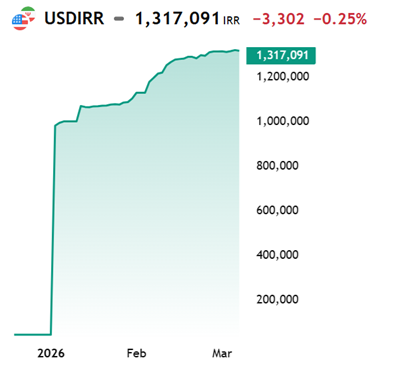
The American/Israeli war against Iran has made the Iranian Rial worthless.