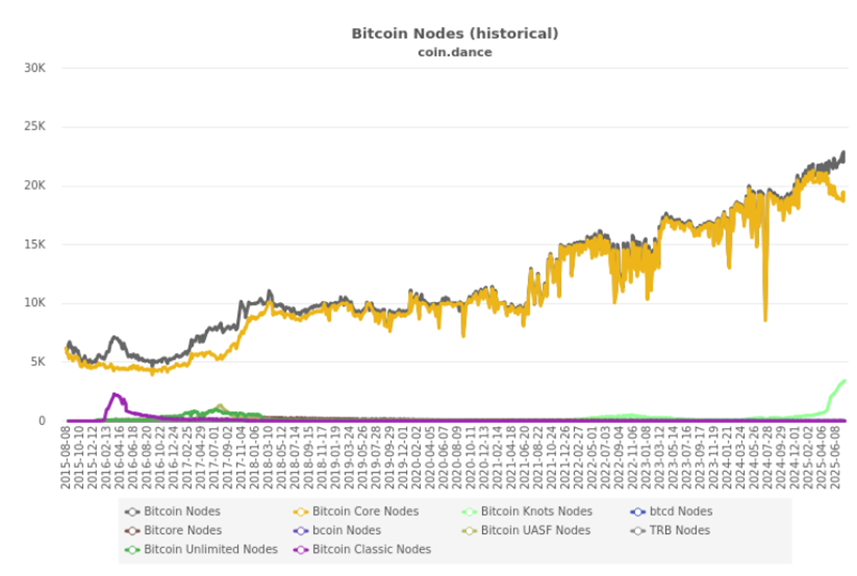
The Bitcoin network is more robust than ever. Recent data from Coin.dance (21 July 2025) shows the number of reachable public nodes has climbed to an all-time high, surpassing 22,500.
This growth signals a healthy, decentralized network. Yet a closer look at the software these nodes run reveals a deeper debate about Bitcoin’s very purpose.
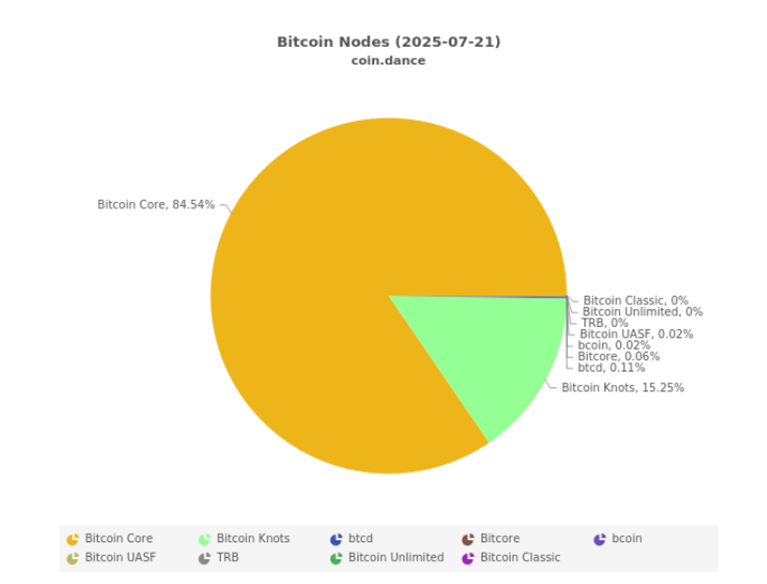
While Bitcoin Core remains the dominant client, an alternative implementation, Bitcoin Knots, has seen a notable increase in adoption. This shift appears to be catalyzed by a proposed policy change in an upcoming Bitcoin Core release concerning data storage on the blockchain.
The Catalyst: A Policy Change for OP_RETURN
OP_RETURN is an opcode that lets users embed a small, provably unspendable data payload in a transaction. Since 2016 (0.12.0), Bitcoin Core’s default relay policy has capped that payload at 83 bytes.
On 5 May 2025, Core developers announced they will remove this 83-byte limit in the October v30 release.
Three key points:
- This is a policy change, not a consensus change. It affects what a node will relay or accept into its mempool, not what makes a block valid.
- The 4 million-weight-unit (≈ 4 MB) block-size limit is unchanged.
- No one is forced to change. Operators may skip v30 or run clients such as Bitcoin Knots that enforce stricter rules.
This seemingly minor technical adjustment has reignited a long-standing philosophical debate, creating two distinct camps.
Camp 1: Bitcoin Core
Proponents of removing the OP_RETURN limit argue that attempting to define and filter “arbitrary data/spam” is a futile effort. They believe that censorship resistance is a core feature of Bitcoin. If users are prevented from easily storing data via OP_RETURN, they will find more inefficient and harmful ways to do so, such as embedding data in fake outputs, which permanently bloats the UTXO set (the list of all spendable coins) and harms scalability.
From an economic perspective, this view acknowledges that block space is a commodity. The recent wave of “spam” in the form of Inscriptions, Runes, BRC-20 tokens has dramatically increased transaction fees, directly benefiting miners and strengthening the network’s security budget, a crucial factor as the block subsidy diminishes over time. Allowing data storage opens the door to innovation and new business models built on Bitcoin’s foundation.
Camp 2: Bitcoin Knots
On the other side, the community around Bitcoin Knots and its supporters argue that Bitcoin’s primary and most important use case is as a peer-to-peer electronic cash system. They contend that embedding arbitrary data, whether for JPEGs or tokens, is a misuse of a scarce resource. This “blockchain spam” increases the operational cost of running a full node (due to a larger blockchain size) and distracts from the mission of creating a robust global monetary network. For them, preserving the chain for purely monetary transactions is paramount.
You can explore the arguments for and against this change in more detail here and in this Bitcoin Magazine article.
The Unwavering Importance of Running a Node
This entire debate is a beautiful illustration of Bitcoin’s decentralized governance in action. There is no central authority to decree what is right. Instead, the network’s direction is shaped by the choices of individual users and node operators.
Regardless of which philosophy you subscribe to, running your own full node is the most powerful action you can take. By running a node, you don’t trust, you verify. You independently validate every transaction and block according to the rules you choose, ensuring your connection to the genuine Bitcoin network and contributing to its health, security, and resilience.
You don’t need to be a miner to support the network. If the resource requirements of a full node seem daunting, a pruned node is an excellent option that requires significantly less disk space.
Get Started and Download:
- Bitcoin Core: Download the most widely used client here: https://bitcoincore.org/en/download/
- Bitcoin Knots: For those who prefer stricter data policies, download the client here: https://bitcoinknots.org/